
Every founder remembers the relief of that MCA email: name approved. It feels like a green light — as if the government has confirmed the name is yours, safe, and ready to build a brand around.
It hasn’t. And that misunderstanding sends more Indian founders into legal trouble than almost any other early-stage mistake.
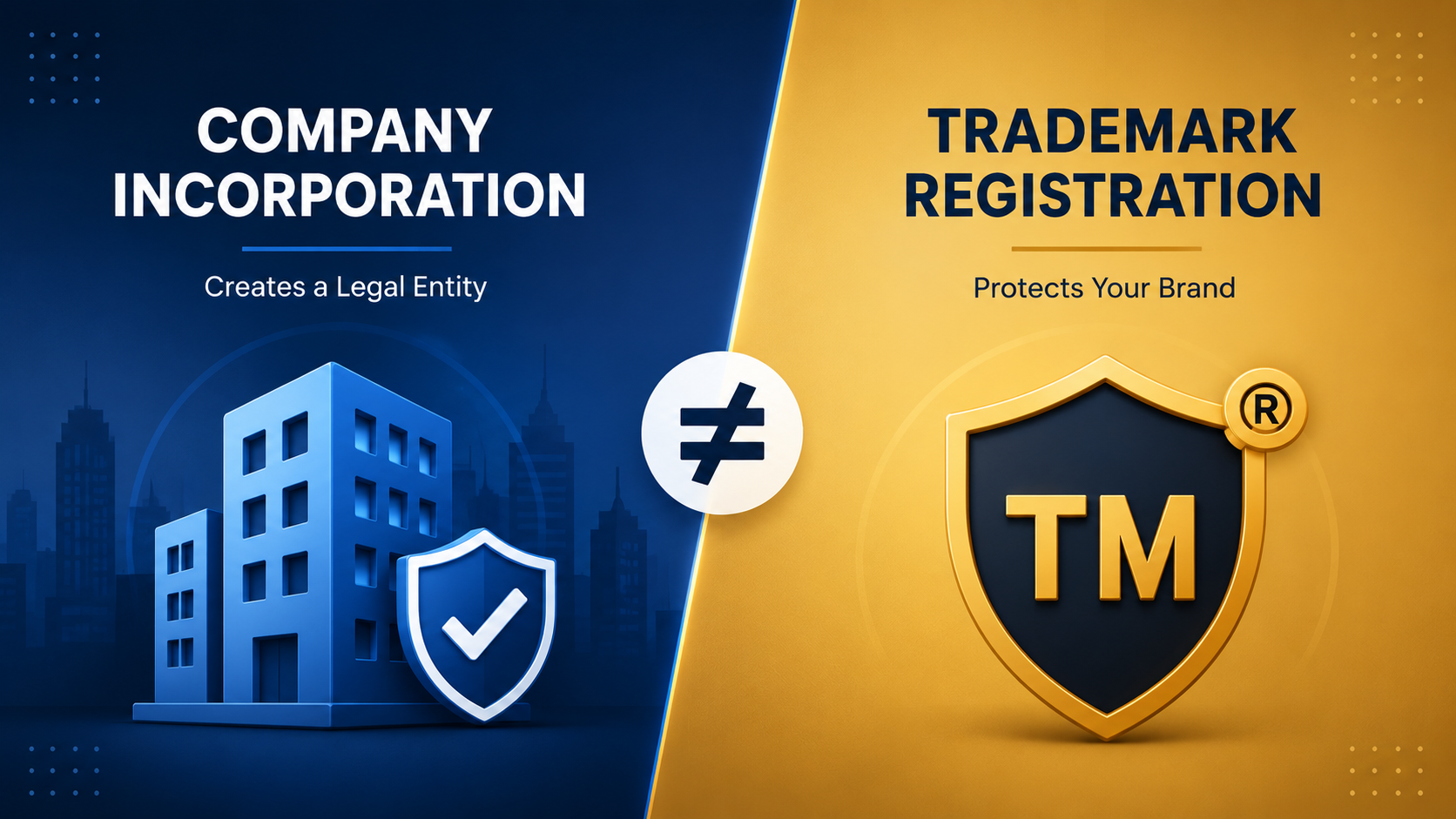
Registrar of Companies (ROC) approval and trademark registration are two completely different legal processes, run by two different authorities, checking two different things. One lets you incorporate a company. The other gives you an actual, enforceable right to stop someone else from using your brand name. Founders routinely assume the first one covers the second — and find out the hard way that it doesn’t.
Why ROC Name Approval Feels Like Protection (But Isn’t)
When you incorporate a company in India, the Ministry of Corporate Affairs (MCA) checks your proposed name against its own register of existing company and LLP names. Under Rule 8A of the Companies (Incorporation) Rules, 2014, the Registrar is also supposed to check the proposed name against the trademark register.
In practice, that check is a basic name-similarity screen — not the kind of structured legal examination the Trade Marks Registry performs when you actually file a trademark search and application. The ROC isn’t evaluating phonetic similarity, deceptive resemblance across goods and services classes, or prior common-law use. It’s largely a database match.
That gap matters more than most founders realize. Passing the ROC name check confirms only that no identical or near-identical company name already exists. It says nothing about whether:
- A registered trademark already covers a similar name in your business category
- Someone has been using an unregistered but well-known version of that name for years
- Your name would be considered “deceptively similar” under trademark law’s much stricter test
So a company can sail through incorporation with a name that a trademark court would strike down in a single hearing.
What Actually Happens When the Conflict Surfaces
This isn’t a theoretical risk. Section 16 of the Companies Act, 2013 exists specifically because this gap keeps producing real disputes. It gives the Central Government (acting through Regional Directors) the power to direct a company to change its name — even after incorporation, even after the business has been operating for years — if:
- The name is identical or too similar to an existing company’s name, or
- A registered trademark owner applies for rectification within three years of the company’s incorporation, registration, or last name change, on the ground that the company’s name is identical with or too nearly resembles their registered mark
Indian courts have applied this provision firmly, and the case law is worth understanding before you assume your name is safe.
In one Delhi High Court matter, a company operating under a name resembling the long-established “Panchhi Petha” sweets brand faced rectification proceedings — with the court examining just how limited the Regional Director’s scope of inquiry is when handling these disputes, and confirming that name similarity concerns can be pursued even against a company that completed ROC registration without objection.
In another case involving the “KCP” name, the court held that Section 16 is a procedural, statutory, and mandatory provision that can prevail even over certain defenses available under trademark law itself — including the argument that a name was derived from a founder’s own personal name. The senior trademark holder’s decades of prior use and established goodwill were enough to force a rectification, regardless of how innocently the newer company had chosen its name.
And in a case involving the Raymond trademark, the Madras High Court upheld an order under the equivalent provision of the earlier Companies Act requiring a company to change its name for being too similar to the well-known “Raymond” mark — reinforcing that trademark rights, once established, sit above whatever name the ROC happened to approve.
The pattern across these cases is consistent: ROC approval is not a defense. Courts treat trademark rights and company-name rectification as running on separate tracks, and a trademark owner does not need to prove actual customer confusion — only that the names are identical or too nearly resemble each other.
The Real-World Cost of Finding Out Late
This isn’t limited to old, sleepy corporate law. Consumer brands have faced the same reckoning in the middle of active operations — a well-known international apparel brand’s Indian restaurant venture was ordered to change its name entirely after a court found it too close to an existing trademark, and it now operates under a completely different name.
For an early-stage startup, the timing is often worse. A forced name change after a product has shipped, a domain has built SEO value, packaging has been printed, and marketing spend has gone into brand recall isn’t a paperwork inconvenience — it’s a full rebrand, absorbed at the worst possible moment. Founders who have been through a trademark dispute describe receiving a legal notice as the first sign that anything was wrong; by then, the company had already been trading under the exposed name for years.
It also affects fundraising. Investors doing diligence increasingly check trademark filing status separately from incorporation status. A company with no trademark application on file, or one sitting on a name with an obvious prior conflict, hands investors a real valuation and risk concern — one that’s far easier to raise before a term sheet than to explain after one.
What To Actually Do About the Gap
The fix isn’t complicated, but it does require treating trademark filing as a separate step — not something the ROC process quietly covers for you.
- Run a proper trademark search before incorporation, not after. Check the Trade Marks Registry’s public search portal using wordmark, phonetic, and class-based searches — not just a company-name database search on the MCA portal. TMZON’s trademark search assistance covers wordmark, phonetic, and class-based checks together.
- File your trademark application (Form TM-A) as early as possible, ideally around the same time as incorporation, not after the business has gained traction. See TMZON’s trademark registration assistance for the filing process and government fee breakdown.
- Don’t treat “name approved by ROC” language as legal cover. If your compliance provider or CA tells you the name is “cleared” because the ROC accepted it, ask specifically whether a trademark search was run — and by whom.
- Pick the right class before you file. Filing in the wrong trademark class is one of the most common reasons a registration ends up not covering the goods or services a business actually offers.
- If you’re already operating under a name and haven’t filed, get a trademark search done now. Finding out you have a conflict before someone else files a rectification application gives you options — rebranding on your own terms, negotiating a coexistence agreement, or filing to establish your own priority date. Finding out after a legal notice arrives leaves you with almost none.
- If you’ve received a rectification notice, trademark objection, or other legal notice already, the three-year window in Section 16(1)(b) and the specific facts of prior use, goodwill, and timing all affect what defenses are realistically available — this is not something to handle without proper legal review of the specific notice. Book a free consultation before responding to anything.
Frequently Asked Questions
Does the ROC actually check trademarks before approving a company name? Rule 8A of the Companies (Incorporation) Rules, 2014 requires some level of check against the trademark register, but in practice it functions as a basic name-similarity screen rather than the detailed examination a trademark application undergoes at the Trade Marks Registry.
Can my company be forced to change its name even years after incorporation? Yes. Under Section 16(1)(b) of the Companies Act, 2013, a registered trademark owner can apply for rectification within three years of your company’s incorporation, registration, or last name change. Separately, Section 16(1)(a) name-similarity disputes between companies do not carry the same three-year limit.
Is a trademark registration the same as a business name or company registration? No. Company/LLP registration with the ROC gives you the legal right to operate under that name as a corporate entity. A trademark registration is a separate right under the Trade Marks Act, 1999 that lets you stop others from using an identical or confusingly similar name, logo, or mark in connection with similar goods or services.
What happens if I ignore a Section 16 rectification order? The Companies Act treats a rectification direction as mandatory once issued, with a fixed compliance window (generally three months) and penalties for non-compliance. It isn’t optional or negotiable once the Regional Director has ruled.
Can I use the ™ symbol if I’ve only filed an application and haven’t been granted registration yet? Generally, yes — many businesses use ™ once an application is filed, while the ® symbol is reserved for marks that have completed registration. This is a common practice point, not a substitute for actually completing the registration process.
This article is intended for general informational purposes only and does not constitute legal advice.
Written by Arya Sharma, Advocate, Bombay High Court | Trademark Attorney
© 2026 TMZON Legal Services. All rights reserved.
